Labels

Showing posts with label farming. Show all posts

Wednesday, July 3, 2013

Who needs a barn?

We have two buildings on our little 12 acres. One is our house; the other is a small shed in which we store the lawn mower, weed eaters, chainsaws, etc. There is nothing in the 1.5ish acres I fenced in for pasture. So what to do for the sheep? They certainly need a reliable shade source to provide relief from the unforgiving summer sun. Here is my solution.

First, I gathered my indispensable post driver. I used this fabulous tool to put up all my fence posts; it seems I am grabbing it to pound in a T post or two at least once a week.

I chose this little piece of bare dirt on purpose. The girls scratched (hooved?) the grass away under the structure in its previous location. I assume the bare earth is cooler. Anyway, I thought I'd save them some work by building their shade source on bare ground.

I place the posts in a rectangle, about 2' x 7' -ish.

Then comes the "hog" panel. Tractor Supply Company defines hog panels as 3' and cattle panels as 5' (if you go to purchase any), but this is a hog panel to me. This panel is 5' x 16'.  It helps to have a helping hand with this step. I never do and I'm always afraid the panel is going to whip back and gouge my arm or face.
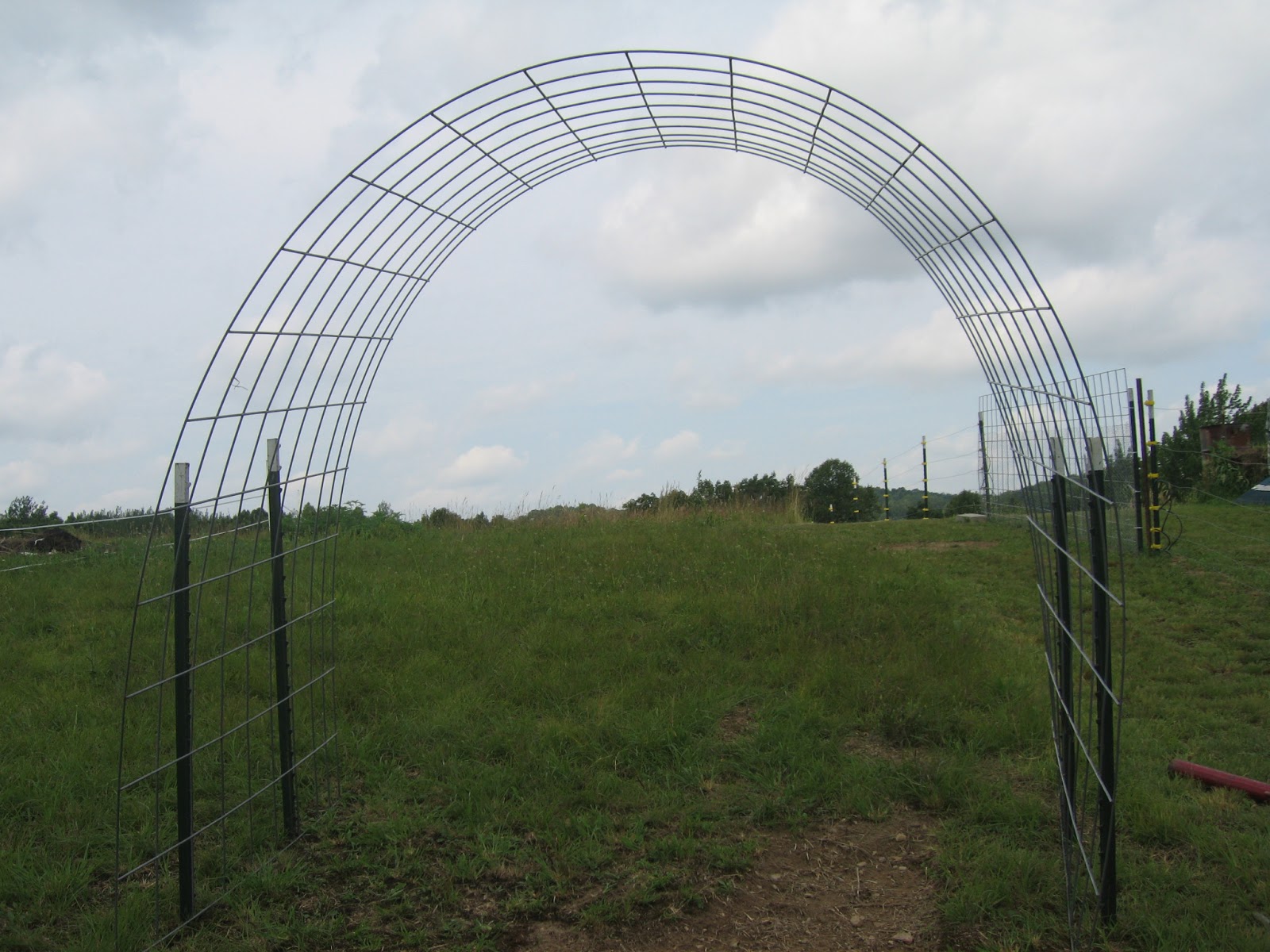
I anchor the panel to the posts with one of my favorite tools - zip ties!

Next comes the tarp and it gets anchored the same way.

And we have an easy, cheap, portable, reusable shade source! I probably should have straightened the tarp, but it was really hot this morning. I used a 10' x 12' tarp. The trick is getting the tarp tight. If it has slack, the livestock won't appreciate it rustling in the wind, not to mention it will probably get blown off in a storm. And yes, this shelter has stood the test of storms and performed admirably. I purposely left a gap at the back so the sheep will benefit from the summer breezes we almost always have on the hilltop.

The sheep enjoy their shade and scratching center.

And cost? rough numbers here: The hog panels are about $30 a piece, T posts about $3, the tarp was about $15, zip ties are pennies. So we have this nice little shelter for approximately $60, not including time or the cost of tools. Not bad at all.

I would guess this could withstand Ohio winters, but I plan to build a straw bale structure for my girls. The winter winds can be pretty vicious up here. 

Monday, July 1, 2013

Shetland Colors


I snapped all these pictures in between pettings. Fairlie tries to climb me when I'm not petting her enough; Bonnie nibbles my shoes or forcefully rubs her head on my legs. So those brown things in the pictures are my knees.


The variation in color is one of the many things I love about Shetlands. There are specific terms to describe colors of Shetland wool.
http://www.shetland-sheep.org/about-shetlands/shetland-colors/ describe the colors this way:

Greys to Black (listed from light to dark)

  • Light Grey
  • Grey
  • Emsket – dusky bluish-grey
  • Shaela – dark steely-grey, like black frost
  • Black

Browns (listed from light to dark)

  • Musket – light greyish-brown
  • Fawn
  • Mioget – light moorit (yellowish-brown)
  • Moorit – shades between fawn and dark reddish brown
  • Dark Brown 
Many Shetlands change color throughout their lives. My own Fairlie is starting to lighten. She may turn a light gray or even an ivory like her mother. I think Bonnie will stay a true brown. Her fleece is lightened by the sun on the outside, so there is beautiful color variation. I can hardly wait to shear them in the spring and try my hand at spinning. They will give such gorgeous fiber.


Sunday, June 30, 2013

My Pastured Poultry

Thanks to my Dad's chicken coop, we were finally able to purchase chicks this spring. It's a lovely little coop that he made himself from scrap parts. He had two windows and built from there. Most of the pieces were found in dumpsters. My chickens have a room with a view.

I researched lots of homesteading books when I was deciding what breed of chickens to purchase. I knew I wanted some Buff Orpingtons. They are a dual purpose bird with decent egg and meat production. They are very good foragers. I mostly wanted them because they are so calm. This was important because I have a very loving and enthusiastic almost-two-year-old.

I wanted a rare/heritage breed, so I referenced my beloved American Livestock Breeds Conservancy http://albc-usa.org/. I chose Dominiques. They are considered the original American chicken breed. http://albc-usa.org/cpl/dominique.html They are excellent foragers and are known to hatch their own eggs. This was an important trait, since I want a self-sustaining flock.

Lastly, I wanted colored eggs, so I threw in some Aracaunas. They are often known as The Easter Egg chicken, since they lay many eggs of green and blue tints.

I ordered my birds from Murray McMurray Hatchery and was quite pleased. http://www.mcmurrayhatchery.com/index.html They were reasonably priced and I received strong, healthy chicks.

Here they are just a few days old. I used a red heat light so they wouldn't harm each other. We all know they peck each other to establish their "pecking order." The order establishes each individual's place in the flock. Each bird can peck all those below him, but none above. But chickens can become cannibals when they are overly crowded. They peck each other, draw blood, then the whole flock is drawn to the red spots and can inadvertently kill one of their own. The red bulb helps prevent this.

And here's a visit to the outdoors on a nice day. I purchased them in March, so they didn't get much time outside until they were feathered. Note the large stock tank I kept them in. I lined it with cardboard to facilitate easier cleaning. When it got too messy, I composted cardboard, pine shavings, and poop all together; I was left with a clean bottom to apply new cardboard and bedding.
And here they are finally in the coop and outside! They were so happy. The coop has two doors on each side, one low for chicken entry/exit and one high for ventilation. Before they were big enough to leave on open pasture, I rotated their fenced area from side to side. When both sides were used, we moved the coop with the skid steer.

These were some boards I had lined up for making a new raised bed. They think I made them a playground.

Here are the Dominiques.

And our king pin.


Why I Chose Shetland Sheep

I have an extremely loving and tolerant black cat, an ornery apricot standard poodle, and pastured poultry, but I have wanted ruminants on our homestead for some time.

I wanted a rare/heritage breed, for reasons I'll share when I'm feeling preachier. Using one of my all-time favorite web sites, The American Livestock Breeds Conservancy http://albc-usa.org/ , I researched different breeds. Storey's Illustrated Breed Guide to Sheep, Goats, Cattle and Pigs was an excellent reference.
http://www.amazon.com/Storeys-Illustrated-Breed-Guide-Cattle/dp/1603420363/ref=sr_1_1?ie=UTF8&qid=1372625134&sr=8-1&keywords=storey%27s+illustrated+guide+to+livestock


Having only a couple acres of our total 12 fenced in for pasture, cows were probably not the best option. Aside from the lack of space, I simply don't like the form cow feces take. Goats or sheep have little pellets that decompose quickly and don't make you feel like showering if you happen to step in a pile. For a final reason, assisting with calving is a terrifying prospect for me.

I considered goats. I visited a Nigerian Dwarf breeder. I have no experience with goats. I know they are notoriously hard to keep in. Dairy goats are apparently quite particular about their shelter; I had no shelter of any kind available for them. I was thrilled with the breeder; she took fabulous care of her animals. I wasn't ready to carry on her quality of care and they deserved someone who would. While I did not purchase any goats, I made a lovely friend and learned a great deal from our visit.

So that left sheep. I grew up around sheep and always swore I would never have any. I thought them stupid, frustrating creatures. I have since learned better. My mother has had sheep for years. My father also spent a large part of his life as a shepherd. I had them to turn to for help. I'm not a fan of mutton, but wool is an astounding fiber and had possibilities for farm income. Finally, sheep are hardy little creatures who prefer being outside, even in harsh weather. I only had to choose a breed.

The aforementioned Storey's Illustrated Guide said Shetlands were docile and easy for the beginning shepherd. That was definitely me! Shetlands have naturally short tails that do not require docking. They are very hardy. They're browsers, like goats, rather than strict grazers (they'll eat vegetation from trees and shrubs instead of just grass). The wool is outstanding for hand spinning. There is an enormous variety of wool colors within the breed. I was sold.

I found the National Shetland Sheep Association, via the ALBC. That led me to a list of breeders. After some time with Google Maps, I chose one who was close and contacted them. I went for a visit and the rest, as they say, is history. 

Fairlie cinched the deal for me. She is a beautiful black lamb with white spots. Her little ears look marbled with the mix of colors. Exhibiting very un-sheep-like behavior, she came right up to me and stood still while I petted her. I petted and petted. My legs eventually got tired, so I sat down. Apparently she felt the same way. She laid down beside me and rested her head in my lap. I was in love.

Fairlie's name means "a rare occurrence." To me, it references her atypical personality. Secondarily it could refer to her lovely spots. Of course she needed a buddy. I chose a little brown beauty, whose name is Bonnie. They're my girls.

Pasture Rotation and Sheep Worming

My Shetland girls, Fairlie (meaning "a rare occurence") and Bonnie, have been humbly requesting new foraging space. I obliged them this morning. I cleared some space through the wooded area of the pasture and ran the wire. Those plastic step-in fence posts make life so much easier. I simply tied the temporary fencing to the hot wires on the perimeter permanent fence.
I was watching the girls enjoy, nay relish, their new-found forage and thought they might need wormed. I checked the inside of their eyelids and, yes, they were a bit pale, indicating moderate levels of internal parasites. Not wanting to use unnecessary medicine on my natural girls, I mixed some garlic powder and apple cider vinegar, then filled a syringe for each ewe. Knowing they would not appreciate the experience, I picked some wild black raspberries for a post-worming treat.
They were easily caught, wormed, and released with minimum stress to sheep and shepherd.